
The 2026 Student Guide: How to Check Your School's CLEP & DSST Acceptance (New Search Feature)
- Feb 23
- 6 min read
Thousands of colleges accept CLEP and DSST exams for credit, but figuring out which specific tests your school accepts has always been surprisingly difficult.
You've probably called your registrar's office only to be told "check the website," then spent an hour clicking through outdated PDFs. Or maybe you got conflicting information compared to what the transfer office said last week.
That confusion just got a lot easier to solve. CollegeSource recently rolled out a game-changing update to their Transfer Evaluation System (TES) that includes a new "Alternative Credit" search toggle in their Course Finder tool. This feature helps you quickly identify which CLEP and DSST exams your target school accepts: and which courses they replace.
Let me walk you through exactly how to use it.
What Is CollegeSource TES?
CollegeSource operates the largest database of college course catalogs and transfer articulation agreements in the United States. Their Transfer Evaluation System (TES) is used by thousands of academic institutions to evaluate transfer credits and equivalencies.
Many college registrars already rely on CollegeSource behind the scenes when they evaluate your incoming credits. Now, with the 2026 update, students can access similar search functionality directly.
Important note: CLEP and DSST credit acceptance varies by institution, and each school sets its own policies. Always verify your findings with your specific college before registering for any exam.
The New Alternative Credit Search Toggle

The February 2026 update introduced an "Alternative Credit" filter within the CollegeSource Course Finder interface. This toggle lets you search specifically for exam-based credit options like CLEP and DSST exams instead of just traditional course-to-course transfer equivalencies.
Here's what makes this useful: Instead of digging through random PDFs or outdated policy pages, you can now search by institution and see a structured list of accepted exams, the course equivalencies they fulfill, and how many credits you'll receive.
The tool pulls directly from official articulation data that registrars submit to CollegeSource, which means the information tends to be more current than what you might find buried on a department webpage from 2019.
How to Use the Alternative Credit Search
Using the new search feature is straightforward. Here's the step-by-step process:
1. Access the CollegeSource TES Course Finder
Go to the CollegeSource Transfer Evaluation System portal. Some institutions provide direct access through their registrar pages, while others require you to access it independently.
2. Select Your Target Institution
Choose the college or university where you plan to apply or currently attend. The search typically starts by asking you to identify the "receiving institution": that's the school where you want credit to count.
3. Enable the Alternative Credit Toggle
Look for the "Alternative Credit" checkbox or toggle in the search filters. Enabling this option switches the search from traditional course transfers to exam-based credits like CLEP and DSST.
4. Filter by Exam Type
You can usually narrow results by exam provider (College Board for CLEP, Prometric for DSST) and by subject area. This helps you quickly find exams relevant to your degree requirements.
5. Review the Equivalencies
The results will show you which specific exams your school accepts, what course code they replace, how many credits you'll receive, and any minimum score requirements.
Why This Matters: The ROI Angle
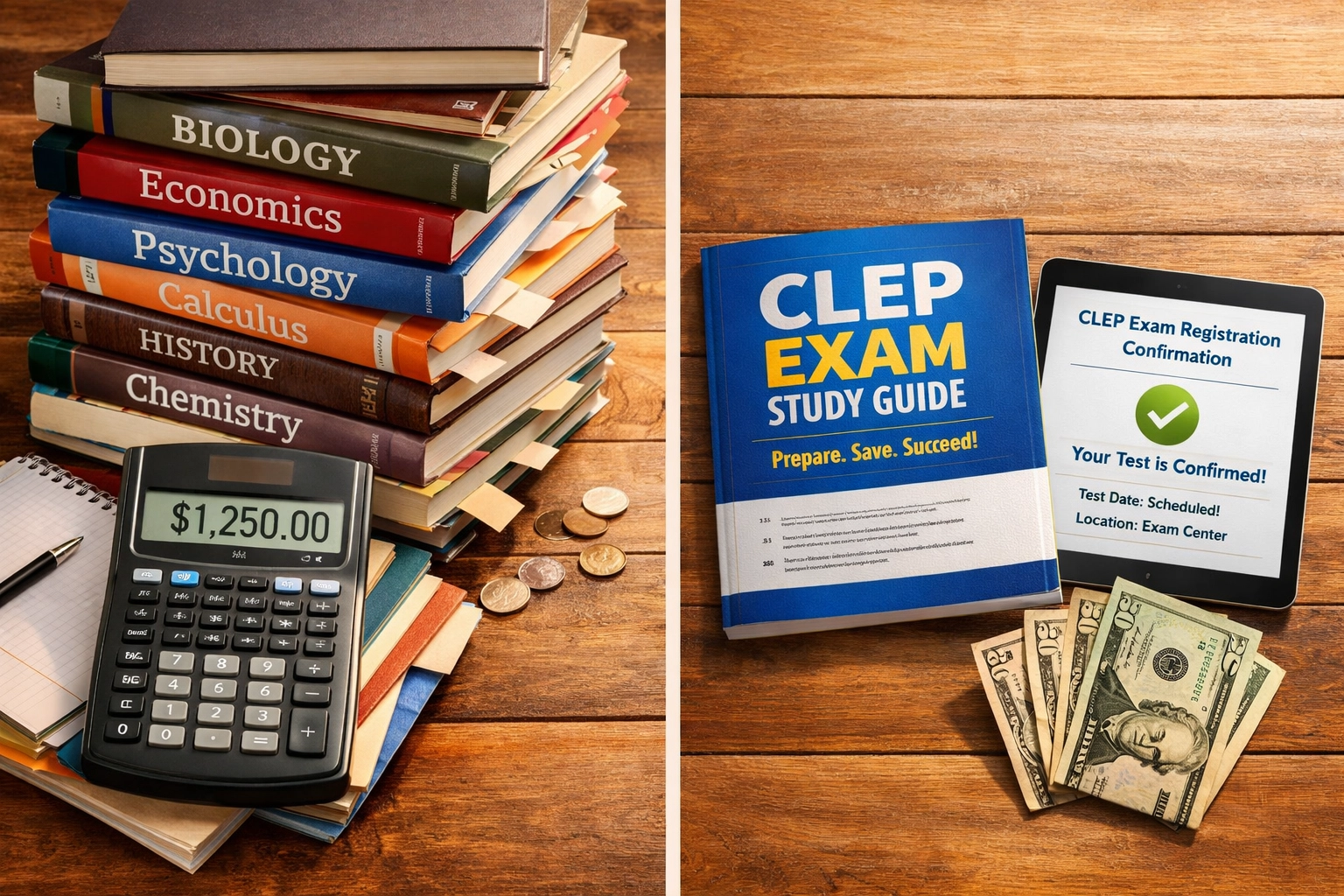
Let's talk numbers for a second.
A typical three-credit college course costs between $1,500 and $2,500 at most universities: and that's just for tuition. Add textbooks, fees, and the opportunity cost of 15 weeks in a classroom, and you're looking at significant time and money.
Compare that to a CLEP exam:
Exam registration fee: $97
Study time: 4-8 weeks on average
Result: Same 3 credits, assuming you pass and your school accepts it
For students looking to accelerate their degree or reduce education costs, that's potential savings of over $1,400 per course. If you earn credit for just five courses through CLEP or DSST exams, you're looking at potential savings of $7,000+ in tuition.
The new CollegeSource search feature makes it easier to identify which exams are worth your time at your specific school, so you can build a strategic test prep plan that aligns with your degree requirements.
What to Check Beyond Acceptance
Finding out your school accepts a particular CLEP or DSST exam is step one. But there are a few other important details to confirm:
Minimum Score Requirements
Most schools require you to earn a specific minimum score to receive credit. The American Council on Education (ACE) recommends a score of 50 for most CLEP exams (on a scale of 20-80), but individual colleges can set higher thresholds.
Credit Limits
Some institutions cap the number of credits you can earn through exam-based testing. You might find that your school accepts CLEP exams but limits alternative credits to 30 semester hours total.
Course Equivalency Type
Check whether the exam grants credit for a specific course (like "PSY 101") or just elective credit. Specific course equivalencies are more useful if you're trying to fulfill major requirements or prerequisites.
Expiration Policies
A small number of schools impose time limits on exam credits, especially for subjects like technology or foreign languages. Verify whether your credits will remain valid if you transfer or take time off.
How Quick Credit Academy Fits In

Once you've identified which CLEP and DSST exams your school accepts, the next step is preparing to pass those exams on your first attempt.
That's where structured test prep comes in.
At Quick Credit Academy, we specialize in helping students prepare for CLEP and DSST exams through focused study materials, practice tests, and test prep guidance. Our $49 per month membership gives you access to our full study portal, courses, and materials designed to help you study efficiently and strategically.
We also offer live online group classes and tutoring sessions at separate, class-specific pricing for students who prefer real-time instruction and personalized support from a Learning Specialist.
Whether you're planning to test out of one course or ten, having the right test prep resources makes a measurable difference in your results.
Building Your Test Prep Strategy
Now that you know how to verify exam acceptance at your school, here's how to turn that information into an action plan:
Step 1: Identify 3-5 Exams
Start with courses that are required for your degree and align with subjects you already know well or have recently studied. These are your highest-value targets.
Step 2: Prioritize Based on Difficulty
Some CLEP and DSST exams are notoriously harder than others. Research pass rates and preparation requirements, then sequence your exams from easiest to hardest to build confidence.
Step 3: Allocate Study Time
Most students need 30-60 hours of focused study time per exam, depending on prior knowledge. Block out realistic study schedules that fit around your other commitments.
Step 4: Use Quality Study Materials
Random YouTube videos and free PDFs can help, but they're inconsistent. Invest in structured test prep that covers the full exam content outline and includes practice questions that mirror the actual test format.
Step 5: Schedule Your Exams Strategically
Don't cram multiple exams into the same week. Space them out so you can fully prepare for each one and avoid burnout.
Additional Resources to Explore
Beyond CollegeSource, here are a few other tools that can help you plan your exam-based credit strategy:
Take the Next Step
The new CollegeSource Alternative Credit search toggle removes one of the biggest headaches in the exam-based credit process: figuring out what your school actually accepts.
Now that you know how to use it, the next move is yours.
If you're ready to start preparing for CLEP or DSST exams, check out our CLEP test prep courses and DSST test prep resources to get started. We're here to provide the test prep guidance and study materials you need to pass with confidence.
Questions about how exam-based credits work at your school? Our team at Quick Credit Academy is always happy to help you think through your options. Reach out through our contact page anytime.
Quick Credit Academy is an independent test prep provider. We do not grant college credit or provide formal academic advising. Credit acceptance is determined solely by individual institutions.
CollegeSource® is a registered trademark of CollegeSource, Inc. Quick Credit Academy is not affiliated with or endorsed by CollegeSource, Inc.
Quick Credit Academy provides test preparation services for CLEP exams. We are not affiliated with or endorsed by the College Board. CLEP credit acceptance varies by institution. Results may vary based on individual preparation and testing performance.
Comments