
How to Earn 30 College Credits in 6 Months While Working Full-Time
- Feb 21
- 6 min read
You're staring at a degree plan that shows three more years until graduation.
But you've got bills to pay, a career that can't wait, and zero interest in spending another decade in school while everyone else moves forward.
Here's the good news: earning 30 college credits in six months while working full-time isn't just a pipe dream. It's actually doable when you use credit-by-exam programs like CLEP and DSST. These standardized tests allow you to demonstrate knowledge you already have and skip entire courses, potentially saving thousands of dollars and years of time.
Important note: Credit acceptance varies by institution, and results depend on individual preparation and testing performance. Always verify with your college before testing.
Let's walk through exactly how working professionals are accelerating their degrees without quitting their jobs or sacrificing their sanity.
The Math Behind 30 Credits in 6 Months
Traditional college typically operates on the semester system. Full-time students take 12-15 credits per semester, which means 24-30 credits across two semesters (roughly 8-9 months).
But here's what makes credit-by-exam different: you're not sitting through lectures or completing weekly assignments. You're studying independently and taking a single exam to earn the same credits that would normally require an entire semester-long course.
A typical CLEP or DSST exam awards 3 credits. Some award 6 credits for more comprehensive subjects.
So to hit 30 credits in six months, you'd need to pass approximately 10 exams (averaging 3 credits each). That breaks down to about 1.5-2 exams per month.
Is this aggressive? Absolutely. But when you compare it to juggling four traditional classes while working full-time, the math suddenly makes more sense.

Strategy #1: Choose Your Exams Wisely
Not all college credits are created equal when you're racing the clock.
Start with subjects you already know. If you've been working in business for five years, Business Law or Principles of Management might require minimal study time. If you read constantly, Analyzing and Interpreting Literature could be a quick win.
Here's how to build your exam list:
Step 1: Review your degree requirements and identify general education courses you still need
Step 2: Check which CLEP and DSST exams your college accepts (most regionally accredited institutions accept them, but policies vary)
Step 3: Take practice tests to assess your current knowledge level
Step 4: Prioritize exams where you already have a foundation, these require less study time
Step 5: Mix easier and harder exams throughout your six-month timeline to avoid burnout
The colleges that accept these credits typically require passing scores, which vary by institution. Where accepted, these credits may count toward your degree requirements just like traditional coursework.
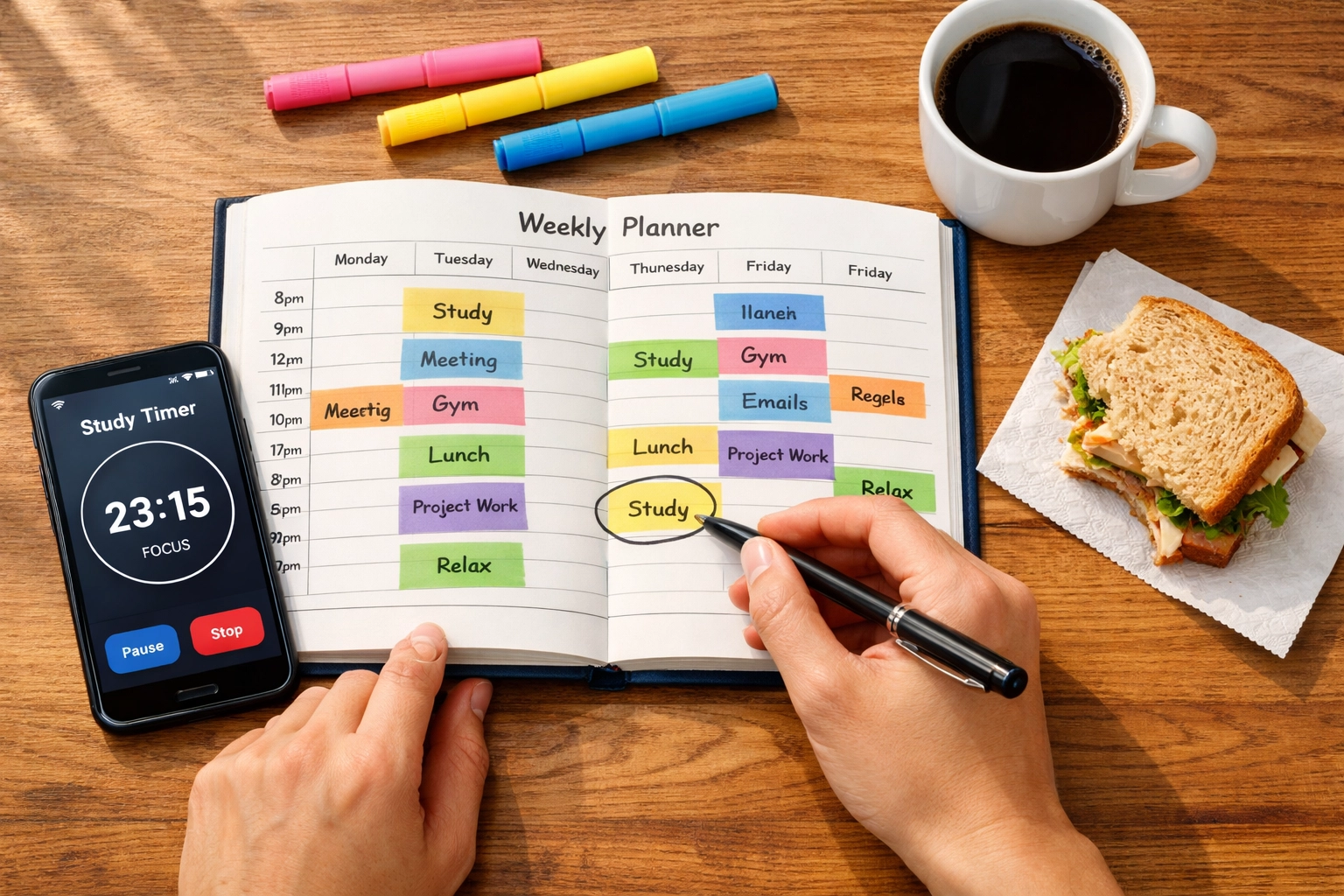
Strategy #2: The Working Professional's Study Schedule
Full-time work doesn't leave much room for error in your schedule. You need a realistic plan that accounts for your actual life, not some fantasy version where you have unlimited energy and zero obligations.
Here's what actually works:
Morning routine (30-45 minutes): Study during breakfast or before work. Your brain is fresh, and you'll knock it out before life gets in the way.
Lunch breaks (20-30 minutes): Review flashcards or watch a quick video lesson. Even small chunks add up.
Evening blocks (1-2 hours, 4-5 days per week): This is your deep study time. Pick the same days each week so it becomes automatic.
Weekend intensive (3-4 hours, one day only): Use this for practice tests and heavy review sessions. Protect the other weekend day for life outside studying.
That's roughly 12-15 hours per week of study time. Multiply that across 3-4 weeks of preparation per exam, and you're looking at 36-60 hours of total study time per test.
Can you pass with less? Sometimes. Some people need more? Absolutely. The key is consistency over intensity.
CLEP vs. DSST: Which Should You Choose?
This question comes up constantly, and the answer is: it depends on your degree requirements and what your college accepts.
CLEP exams are offered by the College Board and cover 34 different subjects. They're widely recognized, over 2,900 colleges accept CLEP credits. These tests cost $93 per exam (plus a small administration fee at testing centers).
DSST exams cover 38 subjects with some overlap to CLEP but also unique options. They're accepted at over 1,900 colleges and also cost $85-$100 per exam depending on the subject.
Here's how to choose:
Check your college's specific policies on both programs
Compare subject overlap, some topics are available through both CLEP and DSST
Read sample questions for each version if you have a choice
Consider study materials availability (CLEP tends to have more prep resources)
Many accelerated students end up taking both CLEP and DSST exams because different tests align better with different degree requirements. There's no reason to limit yourself to one program if both work for your goals.
Balancing Work, Life, and Study Without Burning Out
Let's be honest: adding 12-15 hours of weekly study time to an already full schedule is tough.
You can't do this by simply "finding time." You have to create time, which means something else has to give.
What successful students sacrifice (temporarily):
Television and streaming time
Excessive social media scrolling
Some social activities (not all, you still need breaks)
Weekend trips and extended travel
Perfectionism in other areas of life
What successful students protect:
Sleep (7-8 hours minimum, tired brains don't retain information)
Exercise (even 20-30 minutes helps manage stress)
Key relationships (schedule quality time with family/friends)
Work performance (don't jeopardize your income for faster credits)
Mental health days (taking a week off studying is better than burning out)
The goal is sustainable acceleration, not a six-month sprint that leaves you exhausted and unable to continue.

Creating Your Personalized Six-Month Plan
Now let's build your actual roadmap.
Month 1: Choose and schedule your first two exams. Start studying for exam #1 immediately. This month will feel slow because you're building the habit.
Month 2: Take exam #1 in week 1 or 2. Immediately shift focus to exam #2 while the momentum is strong. Schedule exams #3 and #4.
Month 3: Take exam #2. Begin studying for exam #3. You should be hitting your stride now: the study routine feels more natural.
Month 5: Take exam #5. Study for exam #6. Schedule your final exams (#7-10) based on your remaining degree needs.
Month 6: Complete your final 3-4 exams. Don't overschedule this month: save some buffer for life events or if you need to retake any exams.
This pace gives you 2-4 weeks between exams depending on subject difficulty. Adjust based on your actual performance and energy levels.
The Role of Structured Test Prep
Self-studying from free resources can work, but most working professionals benefit from organized prep materials that streamline the process.
Quality test prep typically includes:
Comprehensive study guides aligned to exam content
Practice tests that mirror actual exam formats
Video lessons for complex topics
Flashcards and memory techniques
Study schedules that map out daily tasks
Quick Credit Academy offers a membership program for $49 per month that provides access to study materials, courses, and resources designed specifically for CLEP and DSST exam preparation. This membership does not include live online group classes, which are priced separately and vary by class.
The structure eliminates the guesswork of what to study and when. Instead of spending hours searching for reliable information, you follow a proven path that thousands of test-takers have used successfully.
For working professionals with limited time, the right prep resources aren't optional: they're the difference between passing efficiently and wasting months studying the wrong material.
Your Next Steps
Earning 30 college credits in six months requires commitment, but it's genuinely achievable when you have the right strategy and support system.
Here's what to do today:
Check with your college about which CLEP and DSST exams they accept
Identify 10 exams that align with your degree requirements
Take a free practice test to gauge your starting point
Choose your first exam and set a test date 3-4 weeks out
Get access to quality study materials so you're not wasting time
If you're ready to accelerate your degree without sacrificing your career or your sanity, explore Quick Credit Academy's test prep resources and discover how structured preparation can cut your study time in half.
The degree you've been putting off doesn't have to take another three years. With the right approach, you could be significantly closer to graduation by this time next year: all while keeping your day job.
Legal Disclaimer:
Quick Credit Academy provides test preparation services for CLEP exams. We are not affiliated with or endorsed by the College Board. CLEP credit acceptance varies by institution. Results may vary based on individual preparation and testing performance.
Comments