
How to Check if Your College Accepts CLEP: The New CollegeSource 'Alternative Credit' Hack
- Feb 24
- 5 min read
You're ready to save thousands on tuition by testing out of college courses.
But then you hit a wall: does your college actually accept CLEP credits?
You check the College Board search tool. Your school isn't listed. Or the information looks outdated. You email the registrar and wait days for a vague response. Meanwhile, you're stuck wondering if studying for that exam is even worth your time.
Here's the good news: there's a new way to check CLEP acceptance that most students don't know about yet.
The CollegeSource TES 'Alternative Credit' Update
In November 2025, CollegeSource quietly rolled out a game-changing update to their Transfer Evaluation System (TES).
They added a dedicated "Alternative Credit" search category.
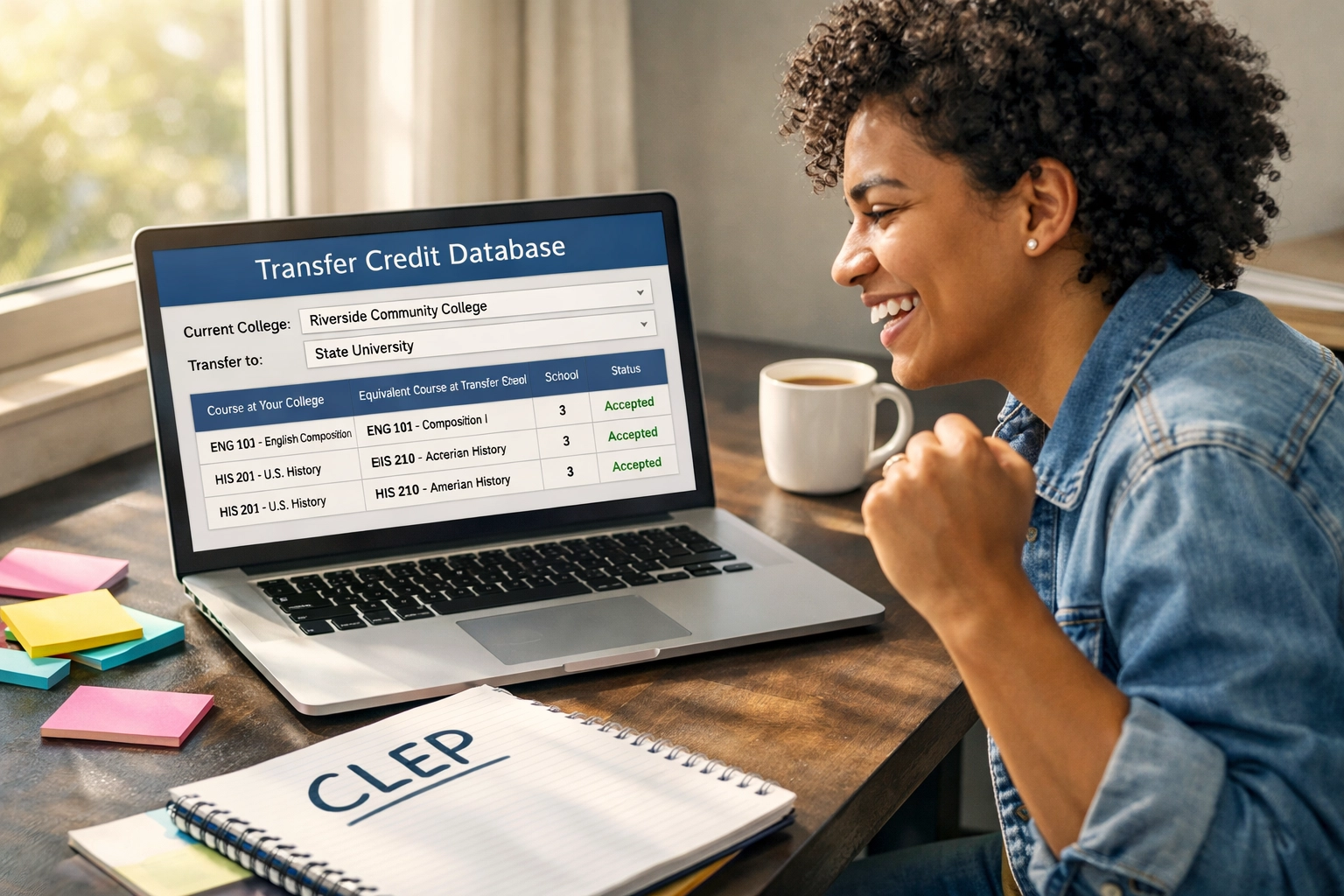
This is huge. CollegeSource TES powers the transfer credit databases for over 1,400 colleges and universities. If your school uses TES, you now have a direct way to search for CLEP, DSST, and other exam-based credit policies, right in the same system that tracks traditional transfer credits.
Before this update, you had to dig through registrar websites, generic policy pages, or outdated PDF documents. Now? The information lives in one searchable database where accepted colleges already manage their credit policies.
Quick Credit Academy provides test preparation services for CLEP exams. CLEP credit acceptance and policies vary by institution.
How to Check if Your College Uses TES
First, you need to confirm your college uses CollegeSource TES.
Here's how:
Go to your college's website
Search for "transfer credit equivalency" or "transfer credit database"
Look for links that mention "TES," "Transferology," or "CollegeSource"
Many schools integrate TES directly into their registrar or admissions pages. You might see it labeled as "Transfer Credit Tool" or "Course Equivalency Guide."
If your school uses Transferology (the student-facing portal powered by TES), you're in luck. That's your gateway to the Alternative Credit search.
Step-by-Step: Using the Alternative Credit Search
Once you confirm your college uses TES, follow these steps to check CLEP acceptance:
Step 1: Log into Transferology
Go to Transferology.com and create a free account. Add your current or intended college as your destination school.
Step 2: Navigate to Alternative Credit
Look for the "Alternative Credit" tab in the main navigation. This feature rolled out in late 2025, so if you created your Transferology account before November, you might need to refresh or update your profile.
Step 3: Select Exam Type
Choose "CLEP" from the exam type dropdown menu. You can also search DSST, AP, IB, and other exam-based credits here.
Step 4: Search by Subject
Enter the specific CLEP exam you're interested in, like "College Algebra" or "Principles of Management."
Step 5: Review Credit Policy
The system displays:
Whether your college accepts the exam
Minimum passing score required
Number of credits awarded
Course equivalency (what class it replaces)
Any restrictions or conditions
This information comes directly from your college's TES database, so it's often more current than what you'll find on the College Board's general search tool.

Backup Methods to Verify CLEP Acceptance
Not every college uses TES or Transferology.
If your school doesn't appear in the CollegeSource system, try these backup methods to check CLEP acceptance:
College Board's Official Policy Search
The College Board maintains a searchable database of 2,900+ institutions that accept CLEP credit. Visit the CLEP College Credit Policy Search on the College Board website.
Search by your college name. The results show which exams are accepted, required scores, and credit hours awarded.
Important note: This database depends on colleges self-reporting their policies. Some schools don't update it regularly. Always verify with your specific institution.
Direct Contact with the Registrar
Email or call your college's registrar office directly. Ask these specific questions:
"Does [College Name] accept CLEP exam credit?"
"What is the minimum score required for [specific exam]?"
"How many credits will I receive?"
"Does this credit count toward my major or only as elective credit?"
"Is there a maximum number of CLEP credits I can apply toward my degree?"
Request written confirmation if possible. Policies can change, and having documentation protects you.
Check Academic Department Policies
Some colleges have institution-wide CLEP policies, but individual departments may have additional restrictions.
If you're testing out of a course in your major, contact that department directly. A nursing program might not accept CLEP for science prerequisites even if the college generally accepts CLEP credits.

The ROI: Why This Matters for Your Wallet
Let's talk numbers.
The average cost of a 3-credit college course ranges from $1,000 to $2,500 at public universities. Private colleges charge even more, sometimes $3,000 to $5,000 per course.
A CLEP exam costs $97.
Add a study guide and test prep resources for maybe $50 to $150 more, and you're still looking at under $250 total.
Pass that exam, and you just saved $1,000+.
Now multiply that across multiple courses. Students who test out of just five general education courses save $5,000 to $12,500 on their degree. That's real money, money you don't have to borrow, earn back through work-study, or pay interest on through student loans.
But here's the catch: those savings only happen if your college accepts the credit.
That's why verifying acceptance before you study is critical. You don't want to invest 40 hours preparing for an exam your school won't accept.
How Quick Credit Academy Helps You Test Out Successfully
Once you've confirmed your college accepts CLEP credit, your next step is passing the exam.
That's where Quick Credit Academy comes in.
We provide test preparation services designed specifically for CLEP and DSST exams. Our $49 per month membership gives you access to our study portal, comprehensive courses, and materials covering the most popular CLEP exams.
Our Learning Specialists offer Test Prep Guidance to help you study efficiently and target the content most likely to appear on your exam. We focus on teaching you the material in a way that sticks, not just memorization, but actual understanding.
Members get:
Subject-specific study guides
Practice quizzes and exams
Video lessons breaking down complex topics
Study schedules and pacing recommendations
Live online group classes and one-on-one tutoring are available separately with class-specific pricing that varies by subject.
Whether you're testing out of one course or planning to knock out multiple exams, our test prep approach helps you study smarter and pass faster.
Explore our CLEP test prep resources to see how we can support your testing-out journey.

Common Questions About CLEP Acceptance
Can I transfer CLEP credits between colleges?
CLEP credits awarded by one college don't automatically transfer to another. Each institution sets its own acceptance policy. If you transfer schools, your new college will evaluate your CLEP credits independently.
Do graduate schools accept CLEP credits?
Most graduate programs accept undergraduate degrees without scrutinizing whether you used CLEP exams. However, some professional programs (medical school, law school) may have specific prerequisite requirements that must be met through traditional coursework.
How long are CLEP scores valid?
CLEP scores don't expire, but college policies about accepting older scores vary. Some schools accept scores earned years ago, while others prefer recent testing.
Can I take the same CLEP exam twice?
Yes, but you must wait six months between attempts. Most students pass on their first try with proper preparation.
Take the First Step Today
Don't let uncertainty stop you from saving thousands on your degree.
Use the CollegeSource TES Alternative Credit search to verify your college's CLEP policies. Check Transferology if your school uses that system. Contact your registrar for confirmation.
Once you know which exams your college accepts, make a study plan.
Quick Credit Academy's test prep resources can help you pass those exams and earn college credit the affordable way. For $49 per month, you get the guidance and materials you need to study effectively and test with confidence.
Results vary based on individual preparation and testing performance, but with the right test prep approach, testing out of college courses is one of the smartest financial decisions you can make as a student.
Get started with Quick Credit Academy and start saving on your degree today.
Quick Credit Academy provides test preparation services for CLEP exams. We are not affiliated with or endorsed by the College Board. CLEP credit acceptance varies by institution. Results may vary based on individual preparation and testing performance.
Comments